May 09, 2009

A Sort of Hiking Trail

We're in the full grip of spring and all the things that come with it: unpredictable weather, allergies, suddenly overgrown lawns, the greening of the hillsides, the swelling of the river and, finally, an opportunity to do some hiking. There's no shortage of hiking destinations in these parts, but there is a lack of what we Americans would term "hiking trails." This frustrated us during our first spring and summer. From the municipality we obtained a rather well-produced hiking map, made in conjunction with a town in Bulgaria as part of a cross-border project. Problem is, the map shows only two "eco-trails" (as they are called) in our greater area. And we've hiked them both.

Turns out we were going about this in the wrong way. It's like the last scene in Back the Future. Marty says, "Whoa, Doc, there's not enough road to get up to 88 mph." And wild-haired Doc Brown smiles and replies, "Roads? Where we're going we don't need any roads." And the Delorean lifts up from the ground and blasts off into the sequel.

Trails? Where we're going we don't need any hiking trails. We just pick a village and start walking.

There are three distinct settlement types in Macedonia: cities, towns, and villages. The cities, like Skopje, Tetovo or Bitola, have a distinct Western bend and include most things you'd associate with America or western Europe: expensive shopping, fast-food, movie theaters, malls, albeit with a blocky concrete/communist twist. The towns? Well, they're just lesser versions of the cities; they hold a certain amount of rustic-ness but also offer enough Western amenities to make you feel comfortable.

When you picture Peace Corps Volunteers serving around the world you probably don't envision them in places like Macedonian towns and you most certainly don't think of cities. No, if you close your eyes and conjure a PCV hard at work, what most closely resembles that image in your head is a Macedonian village. Rural and antiquated, villages are scattered everywhere across Macedonia.

In our municipality there are around 33 villages tucked into the hillsides, ravines and mountain slopes. It's quite common to hear someone in town refer to "my village" or "my family's village." Many families trace their roots back to these small settlements and have relatives still living there. So these villages become destinations in the summer, when their altitude provides some relief from the heat.

Getting to these villages--and getting out of them--is not always easy. Once you leave town, the roads quickly lose their pavement and become rough dirt trails. They're also quite narrow and every half kilometer or so there's a small turnout to assist any drivers that may meet head-on coming up and down the mountain. During the winter one particularly rural village found itself snowed in and Red Cross helicopters were called in to deliver the necessary supplies.

In other words, a walk to a village is all the hike you could ask for. Now we've realized this and begun picking villages at random and setting off. Recently we took a rather satisfying hike with our friend Tina. The original destination was a far-off village but then Tina had the idea of attempting to find some local waterfalls she'd heard lots about.

We were standing at what passes for an intersection in a village. There's a school at the intersection. It's K-8, but serves only ten or fifteen students. [And here's where the communist mentality lives on: I asked a teacher at the high school why the municipality doesn't just drive these students to the central primary school every day, rather than operate an entire school. It'd certainly be cheaper. Her reply: "But then those teachers would lose their jobs."]

At the intersection we came upon two older women who were more than happy to point us in thr right direction. They were en route to a day's work in a nearby field. We passed the field a few minutes later and saw a couple of men tilling the ground with a horse-drawn plow.


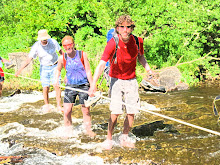
The trail soon ceased to be even that. We were walking along the side of a small river, one which, we hoped, would include some falls. Every 500 meters or so we were forced to cross the river--I couldn't tell if it was the river or our path that was winding. Most of the crossings required a simple leap; others needed some serious ingenuity, like moving a felled tree to create a (very) temporary bridge. We were determined.

Then, in a mass of enormous rocks bordering on boulders, the path ended. The river continued, but we really couldn't see any practical way to go on. Frustrated and tired, we found a seat in a prime landslide spot and had some lunch. While we were discussing the trek back and other things unrelated to waterfalls, Jillian spotted something through the trees. Closer inspection revealed that we had, in fact, found not one, but two small waterfalls. Fifty more meters of scrambling over the rocks and there we were. There was a even a makeshift picnic table constructed at the base of one of the falls. How thoughtful of someone.

So we sat there for awhile, beside two waterfalls, near a village, on no hiking trail, in Macedonia.


May 01, 2009

The Kids Are Alright

This time I was prepared. Like a Discovery Channel photographer lying in wait in the bush for weeks, I'd been studying the habits of this particular herd of children and knew exactly what to expect. No sooner had I given the routine flick of my hand and said "Готово!" (finished) then the kids charged, engulfing us in a monsoon of hugs. This is no exaggeration--forty children jumped up from their seats and bum rushed us. As Jillian said after, "I had to widen my stance to keep from falling over."


We walk to the center every Wednesday afternoon and enter the classroom to a booming chorus of hellos from the thirty or forty kids crammed in there. The room smells of so many unwashed children, so I open the windows. Safet arrives later and closes the windows, owing to the Macedonian belief that open windows cause various illnesses, especially if the draft touches your lower back or neck. Every child wants to greet us individually, to touch us, to shake our hands, hug us, give us a high five. So the lessons always start late.

The lessons are pretty slow going for two main reasons:
  1. The kids insist on showing us every little thing they write. You can imagine how long it might take to reach "ten" when all forty students are intent on showing you the "one" they've just jotted down. I feel a bit of insanity coming on as I repeat браво or супер (bravo, super) for the two hundredth time in only ten minutes.
  2. Sorry to harp on this, but there's FORTY kids in there! I think the first week there was something like fifteen. Then word spread virally around the Edinstvo neighborhood and by the second week kids were sharing chairs. Getting these three dozen bouncy souls to focus on the matter at hand is half the battle.
The snail's pace doesn't matter, not really, because it's not so much English classes we're providing as it is a positive activity. Unfortunately, not all of these children attend school, but even for those that do, the combination of antiquated teaching methods and the marginalization of Roma students means very little in the way of personal attention. They crave it. And we're delighted to give it.


When the hugs are over and the room has been sufficiently aired out, our next group arrives. Completely different from the previous class and yet equally fun, this group is made up of eight Roma young women, ages 14-20. Bubbly, positive and eager to get to know us, these ladies are a real joy to work with. Again, there's not a whole lot of English being taught and learned, but that isn't so important considering the relationships we've formed with them.

One of the young women, Sarita, who, at age 20, is the oldest of the group, recently discovered I have a brother. First she told me to pass on a greeting to him. Then she asked to see a picture. She was impressed--apparently he's better looking than me. She asks how he is and when Jillian says, "Sarita, you'll have to learn English to get to know him," Sarita replies, "Why do you think I'm coming to these classes?"

So, Matt, book your return ticket now.

These young women, like many in Macedonia, are particularly enthralled with Jillian's appearance; fair skin, green eyes and long red hair are generally unknown in this part of the world. Despite that very awesome Irish pub in the nearby city of Kumanovo, the Irish themselves are not well represented here. Many women in Macedonia dye their hair--in fact, one of the most expansive sections in our local market is the shelf of hair color dyes--and Jillian is often asked "what number" her hair color is on the product scale. A genetic number, ladies.

During class this week, our students decided to play dress up with their little Irish doll. To class they brought a traditional Roma wedding dress and had a blast preparing Jillian as if she were about to walk down the aisle. The dress itself seemed, to this male observer, to be an elegant mix of Queen Elizabeth and Battlestar Galactica.

Jillian was a great sport about the whole thing, especially later, when the girls insisted on dancing a traditional Macedonian/Roma step with her in the attire. What an odd scene: Jillian, in a Roma wedding dress, dancing with our new friends around a pre-school classroom while a Balkan folk song blasted from Sarita's cell phone.

That's way better than English lessons.


Click on "Our Photos" on the right sidebar to see more pictures from the center...and last, but certainly not least, a little video proof of Jillian's wedding dress dancing fun:


April 27, 2009

The "Other" Part of Town

I want to rock your Gypsy soul/

Just like way back in the days of old

-Van Morrison, "Into the Mystic"

A strange word that is, Gypsy. It literally refers to that group of people also known as the Roma, but a glance at the word's appendages reveals some deep-seeded feelings about the people and their culture. Take Van Morrison's lyrics; he sings of the romantic Gypsy. This sentiment has been expressed by others, including U2's Bono, who couches a woman's "Gypsy heart" in a song about taming her "wild horses." Nomadic, unconventional, vaguely artsy, hard to pin down--that's the Gypsy of romance and mystery. In other words, a sort of ethnic bohemian. Except that bohemians generally weren't a target of Hitler's Final Solution.

But there's another side to this word that reveals some darker feelings about the Roma. Certainly you've heard the phrase "to be gyped", as in, "He gyped me!" or "He ripped me off!" That precise phrase may not exist in Macedonia, but its central idea sure does: that Roma are nothing by thieves.

And how about the Gypsy moth, that dreaded insect that inhabits a tree just long to completely kill it before moving on to another? This reflects the Western attitude regarding the historically nomadic nature of the Roma people.

Among the 15,000 or so inhabitants of our town, roughly one thousand are Roma. They mainly live on one unpaved street. It’s a slum. Many families don’t have running water or consistent electricity and their roofs leak. Unemployment is nearly ubiquitous. Almost no one has graduated from high school. In other words, if you were to look up the phrase “cycle of poverty” somewhere, this community’s picture would be right there.

The street's called Edinstvo, the Macedonian word for "unity" or "harmony." I couldn't dream up a more bitterly ironic name for this part of town.

The attitude on the part of Macedonians towards Roma in town is one of, if not outright discrimination, severe marginalization. The Roma are, in every sense of the word, "others" and there seems little interest among Macedonians to ever change that.

I was walking from school one day with two seniors from the debate team. Along the way we crossed paths with two Roma teens who attend our English class. I stopped for a second to chat with them about our schedule and then continued on. My Macedonian students looked at me strangely and one asked, "What business do you have with those people?" I explained, but they still seemed puzzled. Their reaction mirrored a common belief here: the Roma can't be helped, they don't want to be helped, so they shouldn't be helped. Don't bother.

Of course, the situation is more complex than the surface suggests. We've heard various, conflicting reports about the municipality' efforts to aid and integrate the community. Did they offer to build new, safe housing for the Roma? Or did they attempt to bulldoze half the settlements because they're an eyesore? Were the candidates for mayor in last month's election making legitimate promises to help the Roma or simply manipulating the most desperate community for votes? With some notable exceptions, Jillian and I have not found a lot of good will toward the Roma and certainly nothing that would translate into municipal support. But we can't be sure.

On the other hand, there is a lot of unity on Edinstvo; it sometimes feels like a town all to itself. When Jillian and I walk up the rough cobblestone street, just barely wide enough for the rarest of car to pass, we are met with waves and greetings from a multitude of adults, teens and young children outside--playing, standing, sitting. It constantly feels like a block party either just wrapped up or is just about to start. Because the community is so small, everyone literally knows everyone else and where they live and always knows what they're doing.

But it's hardly a block party: the living conditions on Edinstvo are quite dreadful. Many of the homes are barely fit to be called so. As much as I'd love to document some of this with our camera, I still can't bring myself to take pictures of the homes or the trash-filled gulley that runs directly down the center of Edinstvo like a polluted artery. I think it'd feel like some kind of sick voyeurism.

Instead we take pictures of the children. Between our work at the kindergarten and weekly English classes we teach for Roma kids and teens, we've developed some really nice relationships with them. And they just love getting their pictures taken and then looking at them on our camera's tiny viewing screen. Like sadistic mathematicians wielding permutations on their hapless victims, these kids seem to figure every conceivable combination for posing in photographs and then insisting we take them all. From a recent trip to the neighborhood:


There's so much more to say about this community and the relationships we've established there and the kindergarten. But it will have to wait. We'll keep you posted.