May 27, 2009

Marathon Over the Mountain

"I can't wait to go to bed tonight," said Conor.


He and his wife, Kacey, both PCVs, were visiting us for the weekend and all four of us were sitting in the town square. It was pitch dark, which lent the impression that bedtime was, indeed, a near event.

Actually, we'd been up only twenty minutes. It was a few strokes before 4 a.m. and though the sun would eventually bring with it temperatures in the 80s, an early-morning breeze had us huddled and hugging ourselves on the pavement as we awaited our taxi. Along with thirty or so other hikers, we were catching a ride to a monastery in the village of Lesnovo and then hiking back over the mountain range to our own town's monastery. The day's grand total: 44 kilometers, or 27 miles; the local hiking club's annual marathon hike. So at that particular moment bedtime felt like years away.

Spurred on by too many cups of Turkish coffee and encouraged by constant Formula 1 coverage, the taxis spent the next ninety minutes passing each other on the windy mountain roads all the way to Lesnovo. Now exhausted and carsick, we explored the Lesnovo monastery where Jillian and Kacey were obliged to wear borrowed skirts due to a monk's presence there. Sunrise over the 800-year old complex noticeably improved our spirits and by the time the group set off up into the hills the weather was already clear and warm.

At the Lesnovo Monastery before the hike

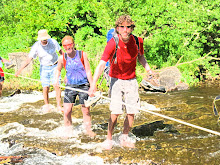
Twenty-seven miles up and over a moutain range is pretty much what it sounds like: really long and really tiring. We passed through no less than half a dozen terrains and I think several microclimates on our journey, including a boggy marsh, a beautiful meadow, some loose boulders and for about 500 meters, a desert. But the hike's best moment came at the river crossing when we waded through with the help of a rope strung across the water's width. It wasn't particularly deep, but the bottom was rocky and dark, making each step a tad precarious. I think everyone crossed with the same thought in mind: I don't want to be the one who falls in.

[I should note here that Conor's dad is currently in the midst of a hundreds-of-miles long trek through northern Spain that began with a climb through the Pyrenees. I reminded myself of that whenever I felt fatigued or sore along the way.]

At a break along the way...10 miles to go!

We reached our destination, the Osogovski Monastery, as dusk approached. Having drunk our weight in water throughout the course of the day, we happily filled our packs with beer just outside the monastery, plunked down at a table, and toasted a great hike. Following a short ceremony, dinner was served to all the hikers, though Jillian and I had to skip out to dash home and shower in time to be two hours late for Bube's graduation party. After 44 kilometers, I could think of nothing better than dancing oro with her grandmother.

No doubt the day's best performance goes to the little black dog who lives at the Lesnovo monastery. When he was still with us after fifteen kilometers, it seemed that he intended to make the hike with us and after he successfully navigated the river it was obvious that he would. As the hike neared its conclusion, we remarked to the trek's leader that this little dog was quite the trooper.

"Oh, him?" the man asked with a shrug. "He comes along every year. Then he walks home alone."

Of course he does. Probably climbs the Pyrenees every few weeks, too.

Crossing the river

With a few miles left, this guy wanted an interview. No chance.

May 24, 2009

When the Stars Come Out

Like we mentioned last year around this time, prom is a big deal in our little town. Sure, the students have been talking about it for what seems like months--but that's normal, I think. What's surprising is the way the prom becomes a public spectacle. Like the circus, it's got something for everyone who lines up outside the motel, four or five deep, to watch the seniors arrive. Girls in new, elegant dresses? Got it. Girls in new, ugly dresses? Got it. Boys in shiny suits and sports shoes? Got that, too. Cars spinning out in the dirt parking lot, coating grandmothers in dust? Oh yeah, there's lots of that. So the flashes snap away as the seniors enter along the red carpet. Jillian and I popped in for a bit to take a few pictures and then left before we got roped into dancing the oro. 


With Bube

Jillian with Bube and Tina

May 18, 2009

Pre-Summer Getaway

As holiday travel goes, even for cheapskate backpackers like us, this was a new one: we'd hitched a ride across Transylvania (central Romania) with a bus of second graders on a school field trip. No, there's no punchline; the driver was playing something like European "Jock Jams" over the bus speakers and a group of rowdy little boys bounced around behind us, singing along as if they were in fact seated in a soccer stadium and not row 17 of a chartered bus. A few parent-chaperones chatted in front of us and David, our friend and a teacher at this particular school, strolled the aisle taking pictures of drowsy kids. Nothing unusual here.


Actually, these kids and our bus trip are a nice object lesson on the world of Transylvania, most often associated with full moons, Dracula, and cloud-enshrouded castles. See, everyone on that bus was speaking German, not Romanian, because they are the descendents of the Saxon Germans who settled in the region centuries ago. The communities they built, called Transylvania by Romanians and most outsiders but referred to as Siebenburgen by Germans for the seven towns that encompass the area, have been impressively preserved and today stand as a beautiful pocket of Central Europe in the heart of the east.

The bus ride from Sibiu to Sighisoara (I'll use the Romanian names for the towns, since that's what shows up on most maps) wound through lush green hillsides. When the vantage point was right, the snow-capped Carpathian Mountains could be seen in the distance. In a grand arc, this range swirls in from the north, sealing off Transylvania from the plains in southern Romania.

The towns in Transylvania large and small have a conspicuously small number of ugly communist-era concrete buildings. In addition to Sibiu and Sighisoara, we also stopped in Brasov, and found all three exquisitely charming with their cobblestone lanes, baroque facades and Gothic churches.

Main square, Sibiu

Clock tower, Sighisoara

All this charm comes cheap: due to the global economic crisis, the Romanian currency, the lei, has lost half its value from this time last year. A tough situation for this newly-minted European Union member, but nice for Western tourists. In other words, you can visit Dracula's castle and buy the black t-shirt depicting some oversized incisors and the words "Somebody in Romania loves me." Or perhaps you'd like to pose with the life-sized doll of Vlad for only two bucks?

Vlad Tepes, a much-celebrated fifteenth century prince known for his exceedingly cruel punishments over those he ruled, was the probable basis for Bram Stoker's vampire. Vlad was born in Sighisoara; there's a plaque on the side of the building, now an upscale restaurant called, you guessed it, "Vlad-Dracula." We didn't go in, but I'd bet their Bloody Marys are fantastic.

We also made it to Dracula's castle--Vlad never actually lived there, but it's where the novel took place. Located in a small village, Bran, the castle is one of a few in the area immediately south of Brasov. We took a local bus and explored these castles. Fittingly, it was the only day of our trip when the weather was damp and cool. Fog hung low over the green hillsides. The castles and the little villages surrounding them were quiet--high tourist season is still a few weeks off--so it was very easy to feel the mysterious allure of the place.

"Dracula's Castle" in Bran

Outside the castle in Rasnov

We like to travel with Trivial Pursuit cards; they help pass the time during travel delays or down time between museums. Here's something that would fit nicely into the History category (and for a yellow chip): What country's parliament building was only the second to have air conditioning, maintained by placing giant blocks of ice in the ventilation system? The answer is Hungary and the city is Budapest, which we visited before our stay in Romania. Situated on an especially wide stretch of the Danube River, Budapest feels both quite large (its population stands at over 2 million) and wonderfully small. Towering churches and palaces are complimented by small, leafy streets and a cafe-oriented, casual speed of life.

No doubt our favorite site was that parliament building. Built in 1902 in the Gothic style, its elegance--or maybe opulence is a better word--is hard to overstate. Seated along the Danube like a crown jewel, the building's exterior brilliance is matched only the interior decor. Let me put it to you this way: the main hall's support beams are painted using 22-carat gold flakes. When eleven thousand of these gold flakes are stacked, they reach only one millimeter high; the artists runs the brush over his face to create static electricity in order to lift the flakes without damaging them as he places them on the...support beams. I can only assume the janitorial staff cleans up with diamond-encrusted mops.

Overlooking the Danube from Buda Castle

One of the many memorials to the Soviet Army

A bronze statue watches Parliament

Walking the streets of the city was a real treat and we enjoyed visiting the Buda side of the river (the city was originally two municipalities, hilly Buda and flat Pest) to see the medieval castle and enjoy views of the river. But an unexpectedly good time was found at the Terror Museum, which I assure you is not so cheesy as the name suggests. Located in a fairly average-looking building along the city's most famous street, the museum documents the crimes perpetrated on the Hungarian population by both the WWII-era fascist regime and the post-war, Communist government. In both cases, state secret police housed their headquarters there, where thousands of people were detained, tortured and executed.

The man we stayed with in Budapest is Hungarian on his mother's side. His grandfather once told him that everyone knew what was going on inside that building and whenever he would pass it on the street he would remove his hat in respect to the victims.

Constructed only six years ago, the Terror Museum is perhaps the most stylish and persuasive museum we've ever visited. Its designers did a wonderful job combining images, light, sound, and period pieces to create a very compelling and disturbing picture. Indeed, more than a museum, this is a place where a country is coming to terms with its past. Point: as the tour ends and homage has been paid to the victims, visitors enter a narrow passageway filled with photos. Below each photo is a name. These are the criminals, the Hungarian men and women who took part in the shadowy terrorization of their own population. What jumped out at us about this display is that many of these people are still living. I think this museum took great courage.

Well, I've just about gone on as long as the Danube, so I'll conclude. As always, more photos can be seen by clicking on "Our Photos" on the right sidebar. This was a great getaway before the summer rush. Healthy Kids Day Camp is now in full swing with preparations and the weather has turned hot. Summer, we welcome thee with open arms!