September 14, 2008

Backpacks, Borders and Beer

This small town doesn't really do advertising. For any given event, whether it's a Red Cross fundraiser or an art exhibition, you're lucky if a few fliers find their way up in store fronts. Eerily, about the only thing that's well-publicized around here is death, in the form of announcements posted on telephone poles.

But then it's not really that important around here, in this town where word of mouth spreads faster than internet chain mail. A culture based on personal relationships and socializing doesn't really need posted announcements to know what's going on--sitting down to coffee with your neighbors is a better source of local events than checking email or reading fliers in the library windows could ever hope to be.

Problem is, unless someone specifically seeks us out, sits us down, and talks Baby Macedonian to us, Jillian and I won't really pick up on the word of mouth network. More than once, I've been asked by one of the teachers or students at school why I didn't attend such-and-such. Well...because this is the first I'm hearing of it.

So imagine my delight when, walking home from school a few days ago, I crossed paths with the head of the local hiking club whom informed me that there was an organized climb of the region's highest peak on Saturday. Then she said something else. I didn't catch it, but felt lucky to have the day and time of the hike. That something "else" was of some importance, and it sure was one hell of a surprise yesterday...

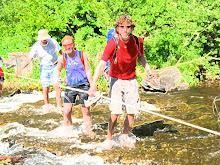
So about this mountain. It's called Ruen--or, literally, "Mt. Everest of Northeastern Macedonia"--and its peak sits directly on the Macedonian-Bulgarian border. Compared with the more majestic and lush peaks in western Macedonia it's not a whole lot to look at, as if someone planted a wide swath of blueberry fields on the moon. The terrain is the stuff ankle sprains are made of--loose, large, hard rocks--but the view was quite impressive and the hike fast. Before we knew it, the group (numbering about 60 people from various hiking clubs around the country) was approaching the summit. At this point many of the long-abandoned military outposts from WWII, crumbling and haunting, were clearly visible along the extended ridge.

National flag? Check. Beer? Check. Let's go.

Jillian near the peak

After a final scramble up a steep incline, we arrived at the summit. And saw around one hundred people already there, eating and drinking. Ummm...? A few Peace Corps volunteers from the other side of the mountain who had hiked up with their own hiking club gave us the scoop:

"Oh yeah, there's supposed to be some sort of ceremony and then we're all crossing over the border for the party...barbeque, beer, dancing."

I glanced down at my clunky hiking boots and tried to imagine doing the oro, the traditonal Macedonian dance that tends to spontaneously erupt at any social event numbering more than three people. Well, this certainly explained why one of our guides on the hike was carrying a backpack bulging with two-liter bottles of Skopsko beer. Over the next hour more people arrived, many by four-wheel-drive vehicles from both sides of border. Border police from both sides stood together, chatting and laughing, as the crowd swelled.

Then the ceremony began. It was a sort of gift exchange between the two sides signalling their peaceful relationship. Well, I'll say. No sooner had that official business ended then everyone high-tailed it over to the Bulgarian border station (a mere 200 meters away), where the grills were already working overtime and the sound of carbonation escaping beer bottles filled the air. And people were dancing.

The fact that all of this was occuring at 7,000 feet on a grassy plateau from which we could see into the infinity of southern Macedonia, western Bulgaria, and southern Serbia, never ceased to be funny. Oh yeah, and there were some horses meandering in the area, no doubt waiting to be photographed for a calendar of inspirational quotes. Sausages were served off the grill and some friendly Bulgarian men invited us over to drink from their pail full of white-wine-and-lemon spritzer.

After a couple hours of this, we heard the by-now familiar shriek of our leader's whistle. It was time to go. At the bottom, we hitched a ride with some Skopje-bound hikers. I sat in the front seat, feeling sufficiently car sick from the twisty road back into town while Jillian sat in the back of the van laughing it up with a rambling old man. He was probably passing on some worthy word-of-mouth information about next year. Who knows? We'll just have our beer at the ready, just in case.

Just your average Saturday spent rejoicing with border guards

On the border with the flags of Macedonia, Bulgaria and the E.U.

September 03, 2008

Back to School

Welcome back, class. Let's begin this brand new school year with that time-honored tradition, the pop quiz.

1. The school supply aisles at Staples and Wal-Mart are jammed packed with moms and dads and shopping carts because

a) Willy Wonka slipped a few Golden Tickets into specially marked packages of
Sharpies.
b) they heard it's where the Libertarian Party is holding its
convention.
c) it's where that old woman giving out cheese samples on
toothpicks is hanging out.
d) it's that season commonly referred to at
OfficeMax corporate headquarters as The Most Wonderful Time of the Year.

2. Which country is in the midst of supplying every student with a desktop computer?

a) United States
b) Russia
c) China
d) Macedonia

Ok, if you answered D for both questions, you get a star. Indeed, it is that time of year again, when millions of American children head back to school. Time to fire up the school buses, pack those brown bag lunches, and wrap up enormous textbooks in protective paper grocery bags. The weather is still warm, your teachers all still seem so nice, the homework still feels so manageable and no one has yet uttered, "How many weeks till Columbus Day?"

Of course, American kids aren't the only ones heading back to school. Here in Macedonia the school year has begun and we're both very glad we're here to see it and take part in it. And so in honor of this new beginning, some observations:

#1: Before you buy the book, check the kid's grades. Perhaps the most startlingly obvious difference between Macedonian and American schools is that students here must buy their own textbooks. The school doesn't supply any. Zero. There are no locked cabinets bursting at the seams with used hardbacks. No spot for the students to fill in their name, the school year, and the condition of the book (which always seemed like the most useless query, anyway). So students buy their books from shops in Skopje, photocopy a friend's book or, more likely, they buy them from students who took the course the previous year. More often than not, books in this third category already have the answers filled in for most of the exercises. While this may sound like a sweet deal for the purchasing party, it leads to some rather hilarious instances of students answering questions in class with positively ridiculous responses. Rather than attempt the question themselves, they'll simply read what was written last year.

#2: This town needs itself a good steam whistle. Most people who bemoan the state of American education point to overcrowding in schools as one piece of evidence. Surely no one wants to cram thirty kids into a classroom and then expect the teacher to give them all the sort of attention they deserve. But what happens when you have 1,100 kids in a school that can hold 500? You get what many communities in Macedonia have, a two-shift school day. For instance, at the high school the day begins at 7:45am. Around 1:00pm there is a mass exodus of teenagers and teachers from the building and into the city center. Thirty minutes later the other half arrive and stay until around 7:00pm. Every two weeks the groups switch shifts.

#3: The proverbial horse and cart are a bit mixed up. There's a scene in Star Trek IV (the one about the whales) in which Chief Engineer Scotty is forced to use a 20th century computer. Describing the PC as "quaint" he begins by picking up the mouse, holding it to his lips and saying, "Hello, computer." So Scotty was a bit too advanced for our primitive desktops, yet I couldn't help but think of him on the first day of school when I saw the evidence of Macedonia's new one-computer-per-student plan. There on the desks, brand new and sleek black, are hundreds of new PCs. Everyone's got one. To be honest, they look great. Ok, but now what? For a country still trying to modernize its teaching practices and curriculum (that's partly why we're here, after all), this is a peculiar move. Teaching with computers is a lot harder than it sounds and that's assuming the teacher is fluent in technology to begin with. Many of the older teachers in town have never used a computer, I'm quite sure. So maybe they have something in common with John McCain, but this doesn't bode well for the use of these particular PCs.

There's the bell, time to go. Hope you took notes, because there will be a quiz next time.

August 16, 2008

Sketches of Spain

Talk about a false cognate: the word "mal" in Macedonian means small, while in Spanish it means bad. So it wasn't terribly surprising when the nice woman behind the counter in Granada raised an eyebrow when I asked for a bad ice cream. This kept happening to us. No longer possessing the acrobatic brain of a child, we apparently are only capable of handling one foreign language at a time. Sure, we both took Spanish for several years in high school and college, but we effectively TNT'd that tunnel shut when we started learning Macedonian. I could almost hear my synapses removing the rubble, searching for daylight, as we examined Spanish menus, deciphered street signs, and asked about bus tickets.

Following the wedding and our visit in Paris [see previous post below], Jillian and I caught an overnight train to Madrid to kick off a week-long tour of Andalusia, the southern region of Spain. As the train rumbled across the French countryside in the waning daylight, we made our way to the dining car and were delighted to find...three-dollar beers! Well, Toto, we certainly weren't in Paris anymore, where beers routinely cost eight bucks. After a surprisingly comfortable sleep as the train crossed through the Pyrenees and descended into the hot lowlands of Spain, we emerged from the train and began our week of tapas, history, and, oh yeah, tons of walking.

Briefly about Andalusia: its incredibly charming and unique character comes from the fact that it was ruled by Moorish Muslims for over five hundred years--in fact, Al-Andus (as it was called) was quite a wealthy and successful center of commerce and culture to the very end, when Ferdinand and Isabel completed the Reconquest and united Spain under a Catholic monarch. Today, Andalusia is largely defined by this incredible mix of Catholicism and Islam, Iberian and Moorish.

The sun was intense and the thermometer was pushing 100 degrees as we climbed the steep grade towards the hills overlooking Granada. It was so much warmer in Spain than it had been in France and, due to an absolute absence of clouds, incredibly bright. We pushed on, though, for our destination was the Alhambra, easily one of Spain's top attractions. Granada was the capital of Al-Andus for many centuries and toward the end of Moorish rule, the Alhambra was built as a centerpiece citadel and palace. Over five hundred years later, it did not disappoint.

The grounds were an exquisite mix of gardens and low-lying buildings of Islamic architecture. At the center was the Nasrid Palace, a wonderfully ornate and detailed structure. The contrast between what we saw here and the plethora of Catholic churches and monuments throughout the region could not have been greater. While the strength of Catholic decor lies in its depiction of people and events--saints, the stations of the cross, Mary, etc.--Islamic design feature no people. In fact, it's forbidden. In its place we found hand-carved murals with elaborate designs and script.

Both pictures: Inside the Alhambra


From atop the Alhambra's fortress wall Granada can be seen in total. In the center of Granada sits a seeming impossibly large cathedral, as if a Catholic spaceship had descended upon the city (close encounters of the Word kind). Staring at this behemoth from the tower of a Moorish citadel only served to reinforce this religious and cultural juxtaposition and reminded us why Andalusia is so interesting.

A short distance from the cathedral is Granada's old Jewish quarter. Due to a relatively high degree of religious toleration during the Moorish period (as opposed to the Inquisition that followed the Reconquest), such neighborhoods are common throughout Andalusia. White-washed walls, confusingly narrow streets of cobblestone, and tiny, tucked away cafes made exploring these areas one of our favorite activities. In Sevilla, the largest city in the region, the Jewish quarter is impeccably kept up and every twist and turn in the streets seems to lead to another undiscovered square or plaza.

Also in Sevilla is a famous bullfighting ring. With all due respect to Ernest Hemingway and the romanticism surrounding this "sport," neither of us had any desire to take in a bullfight. Blindfold the matador, and maybe you'll get me in to see a fair fight. That being said, we had to see the ring. Situated beautifully along the river on Sevilla's main avenue, it really is romantic and dashing, painted in vibrant reds and yellows. Enormous posters advertise upcoming bullfights, the matadors' names announced largely.

Jillian outside the bullring, Plaza de Toros


Also in Sevilla

In addition to Sevilla and Granada, we also visited Cordoba, Toledo, and Madrid. Though technically not in Andalusia, Madrid and Toledo nonetheless pulsated with much of the same flair and history. Toledo, particularly, features a breathtaking old city built during Moorish rule. Along our trip we consumed as many tapas as possible and I think I ate about twenty bowls of gazpacho (by the end of the week, Jillian wouldn't let me order it).

It was a bit strange, but mostly really nice, being back in the west, where buses are clean and air-conditioned, where we were allowed to flush our toilet paper, where the streets weren't cluttered with litter, and where people wait patiently in line. Still, by week's end we were excited to get back to Macedonia (with Jillian's mother...they are touring Macedonia as I write this) and to start planning our school year activities and events.

[As always, many more pictures can be found by clicking on "Our Photos" on the right sidebar.]

Entrance to Old Toledo